


Is mouth taping safe?
The short answer: mouth taping is reasonable to try for many adults whose snoring or dry mouth comes from the mouth falling open at night, as long as they can breathe comfortably through their nose. It isn't safe for everyone. Skip it with a blocked nose, after alcohol or sedatives, for children, or if you have signs of sleep apnoea.
What mouth taping is
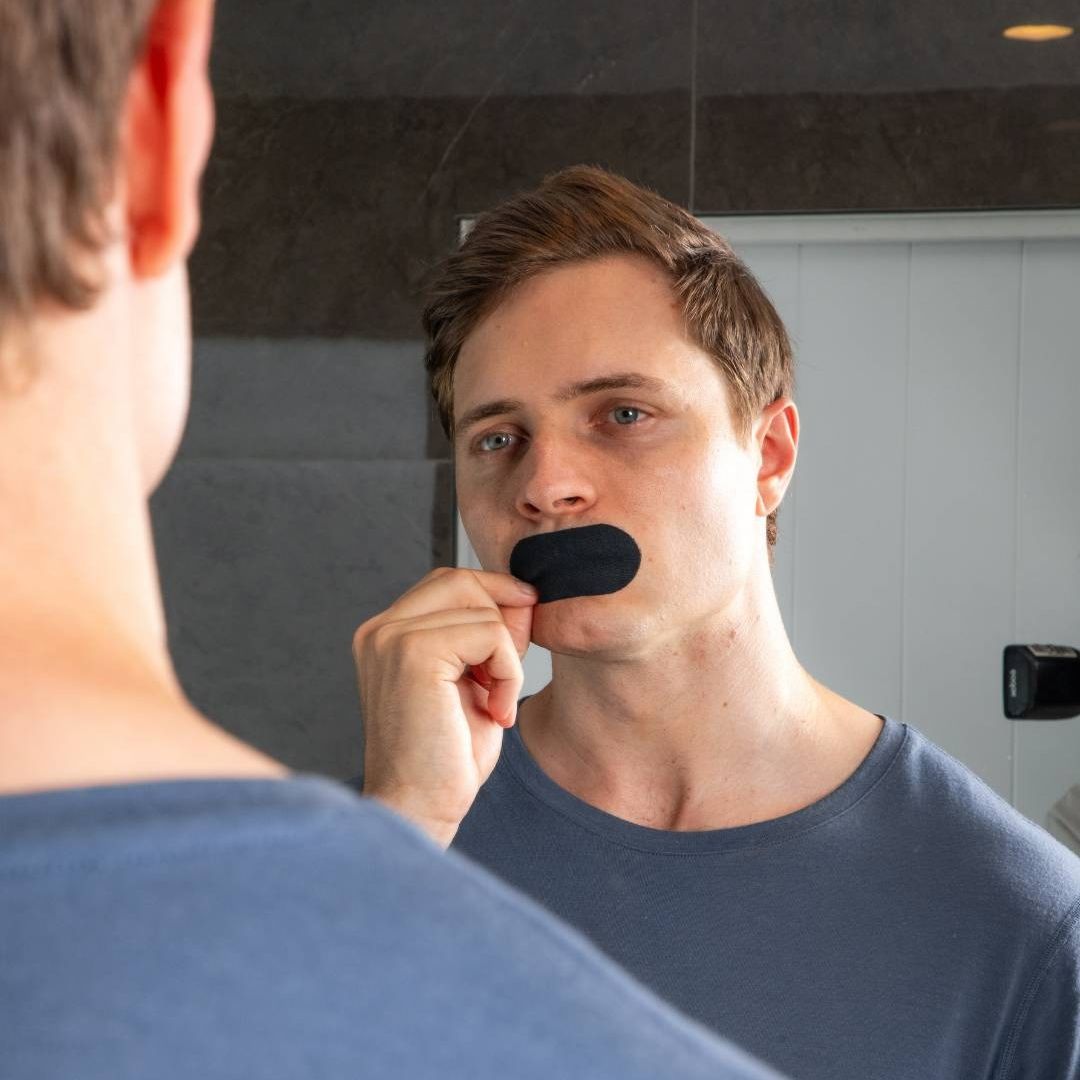
Mouth taping means placing a soft strip across the centre of your lips before bed so your mouth stays closed and you breathe through your nose. People try it for three main reasons: snoring, waking with a dry mouth or sore throat, and a partner who is losing sleep to the noise.
The idea rests on how the airway behaves during sleep. Small laboratory studies show that when the mouth falls open, the jaw and tongue drop back and the airway behind them becomes more prone to narrowing. Air squeezing through a narrower airway is what makes the soft tissue vibrate, and that vibration is the sound of snoring.
What the research says
The evidence for the tape itself is still thin, and it's worth knowing that before you buy any brand, including ours.
- The only systematic review (Rhee et al., PLOS ONE, 2025) found 10 small studies, all rated poor quality. Any benefit was limited to people with mild sleep apnoea and a clear nose. The authors did not support mouth taping as a treatment for sleep-disordered breathing in general.
- In one small study of 20 mouth-breathers with mild sleep apnoea (Lee et al., 2022), the snoring index fell after a week of taping. There was no control group, so the result needs confirming.
- The one blinded trial reported in the review found no significant difference between tape and placebo on breathing events.
- No study has measured side effects of mouth taping properly. That means the risks are unknown, which is different from being proven absent.
What the evidence does support more firmly is the link between open-mouth sleep and waking with a dry mouth. Keeping the mouth closed is a sensible way to reduce that, and it's the benefit our customers mention most.
Who mouth taping may suit
- Adults who breathe easily through their nose when awake and lying down.
- People whose partner says the snoring happens with their mouth open.
- People who wake with a dry mouth, cracked lips or a sore throat.
- People who snore mostly on their back, without pauses or gasping.
Who should not use mouth tape
- Anyone who can't breathe comfortably through their nose. That includes a cold, a hay fever flare, a deviated septum or nasal polyps. If your nose is stuffy, try a nasal strip first. If it still feels blocked, leave the tape off that night.
- Children. In children, mouth breathing is something to get checked, not something to tape.
- Anyone who has been drinking or has taken sedatives or sleeping tablets. These make you slower to wake if your breathing changes.
- Anyone who feels sick or may vomit.
- People with known or suspected moderate to severe sleep apnoea.
- Anyone with an allergy to adhesives, or broken or irritated skin around the lips.
The biggest risk: missing sleep apnoea
Sleep apnoea is a condition in which the airway repeatedly closes during sleep, causing pauses in breathing. Tape can make snoring quieter while those pauses carry on. The danger is that the partner who used to notice the snoring stops noticing anything, and nobody asks a doctor.
See your GP before trying mouth tape, and ask about a bulk-billed sleep study, if any of these apply:
- Someone has seen you stop breathing, gasp or choke in your sleep.
- You wake exhausted most days, or nod off during the day without meaning to.
- You wake with headaches, or get up to the toilet several times a night.
- You have high blood pressure as well as loud snoring.
Mouth tape does not treat sleep apnoea.
How to try it safely
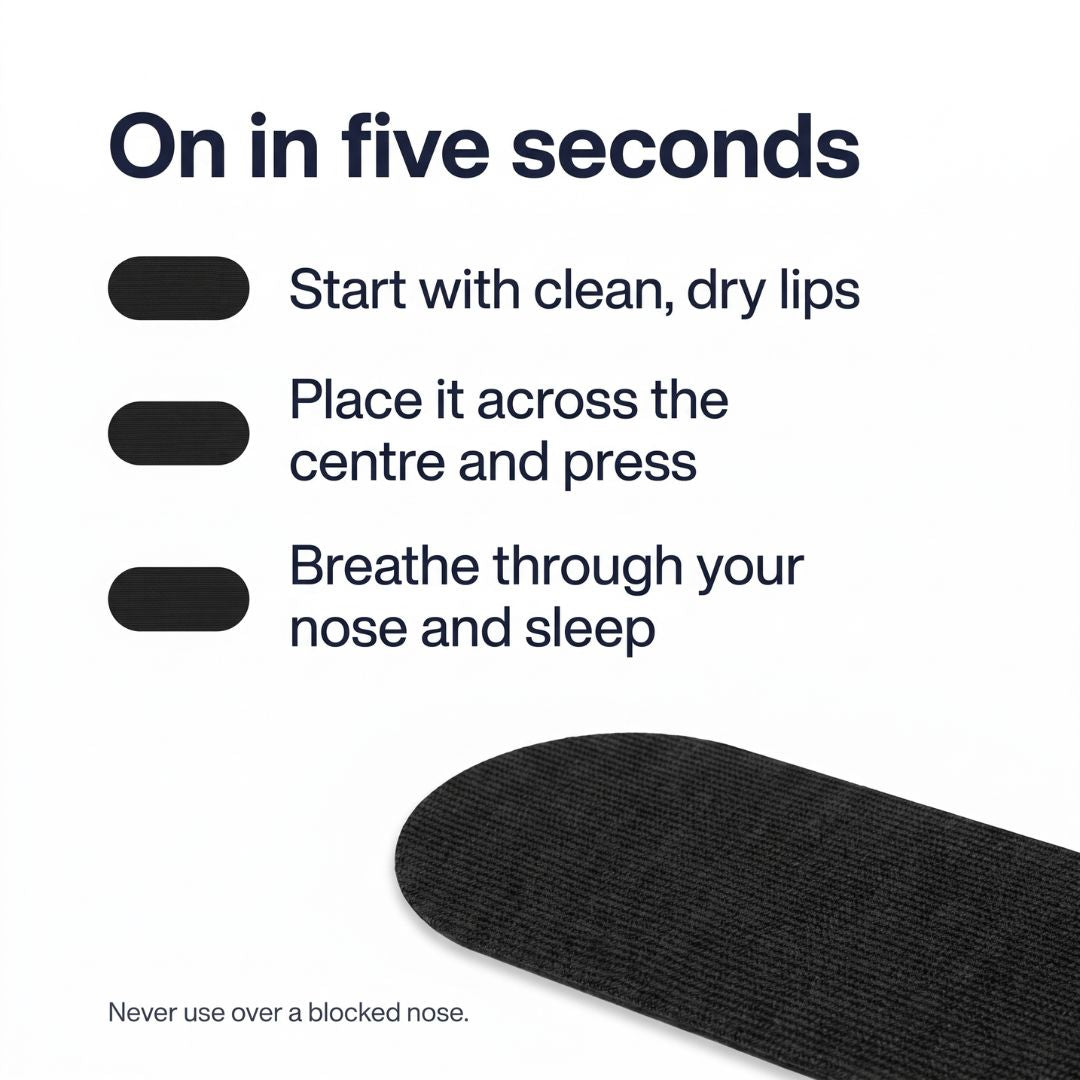
- Check your nose first. Close your mouth and breathe through your nose for a minute. If that's a struggle, don't tape tonight.
- Start awake. On the first night, wear the strip for ten minutes while you read, so you know how it feels.
- Clean, dry lips. Skip the lip balm, which stops the adhesive gripping.
- Place it across the centre of your lips and press gently.
- Peel it off slowly in the morning, corner first, with steady pressure. If your skin is thin, moisturise after.
What to look for in a mouth tape
Skin trouble and tape falling off overnight are the most common complaints in mouth tape reviews. A purpose-made strip should be breathable, gentle to remove and tested for skin safety. Check whether the brand can name its tests.
For transparency, here is what's behind ours. Elite Sleep Mouth Tape is 95% cotton and 5% spandex with a Henkel medical-grade adhesive. The adhesive was independently lab-tested to ISO 10993 and caused no skin sensitisation. The tape tested free from PFAS (not detected, EN 17681-1:2025), passed a REACH screen for 250 substances of concern, and is latex-free and fragrance-free.
Common questions
What happens if my nose blocks up during the night?
Most people wake when breathing gets harder and can peel the strip off. That's why the rules above matter: a clear nose at bedtime, and no tape after alcohol or sedatives, which dull that waking response.
Is paper tape from the chemist fine?
Some people use it without trouble. Paper tape isn't made for the lips, though, and it can pull at the skin or come off overnight. Whatever you use, the same safety rules apply.
Will mouth tape stop my snoring?
It may help when the snoring comes from the mouth falling open. It won't help snoring that starts in the nose or throat, and nothing on this page replaces a GP check if you have the warning signs above.
Can I use mouth tape with nasal strips?
Yes, and many people do: strip on first, then tape. The combination hasn't been studied, so treat it as a sensible routine rather than a proven result. Our guide Mouth tape or nasal strips: which do you need? explains when to use each.
Try it for 30 nights
If mouth tape suits you, ours is skin-tested and latex-free, and every order comes with a 30-night money-back guarantee, opened packs included.
See the mouth tapeSources
- Rhee J et al. (2025). Breaking social media fads and uncovering the safety and efficacy of mouth taping: a systematic review. PLOS ONE.
- Lee YC et al. (2022). The impact of mouth-taping in mouth-breathers with mild obstructive sleep apnea: a preliminary study. Healthcare.
- Oksenberg A et al. (2006). Dry mouth upon awakening in obstructive sleep apnea. Journal of Sleep Research. PubMed 16911034.
- Fitzpatrick MF et al. (2003). Effect of nasal or oral breathing route on upper airway resistance during sleep. European Respiratory Journal.
This guide is general information, not medical advice. If you're worried about your snoring or your breathing at night, talk to your GP.